|
| An interesting relationship |
The recent death of Robin Williams has again raised questions about the link between creativity and mental illness. This question has been one of the most popular in the Intro Psychology classes that I've taught and also one that sparked the most discussion. Interest in this relationship stretches back centuries to prominent philosophers and authors.
"Those who have become eminence in philosophy, politics, poetry and arts all had tendencies towards melancholia"
Aristotle
Seneca: “No great genius has ever existed without some touch of madness.”
Seneca
“The lunatic, the lover, and the poet / Are of imagination all compact.”
Shakespeare
“Great Wits are sure to Madness near ally'd / And thin Partitions do their Bounds divide.”
Dryden
Attempting to answer the questions suffers somewhat from a selection bias. A brief look in to historical figures who were creative in their own ways, captures a "whose who" of celebrities including: Abraham Lincoln, Ludwig van Beethoven, Leo Tostoy, Tennessee Williams, Van Gogh, Issac Newton, Hemingway, Dickens, John Nash, Kurt Cobain, Richard Dryfuss, Catherine Zeta Jones, Ozzy Osbourne, Robin Williams... To put it another way, there are a number of creative people who have mental illness, but there are a number of mentally ill who are not creative.
Depending on the definition of creativity, there appears to be a higher rate and intensity of symptoms in eminent creators than in the general population with depression the most common symptom along with correlates of alcoholism and suicide. A corollary on this finding is that the rate and intensity of symptoms depends on the specific domain of creativity, such as psychopathology which is higher among artistic creators (Andreasen, 1987; Jamison, 1989).
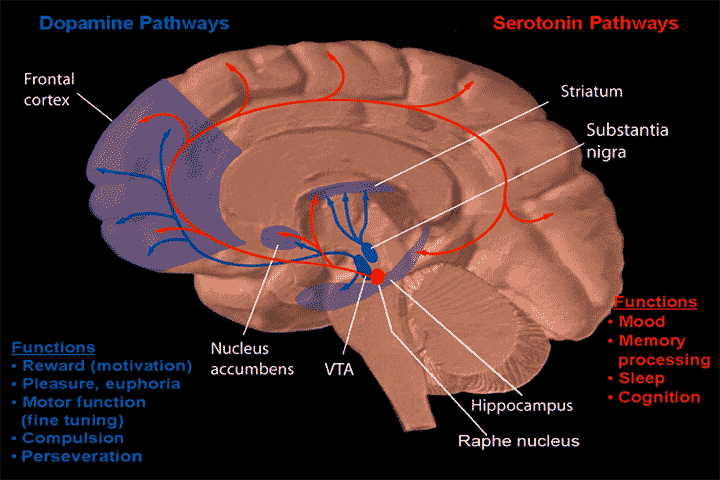
Much of the work linking creativity to specific brain structures have come from disorders with frontal pathologies. Evidence from psychiatric conditions that affect the frontal lobes such as schizophrenia (Folley & Park, 2005), depression (Post, 1994), and attention deficit disorder (ADHD; White & Shah, 2006) as well as the neurologic deficits of these illnesses, whether in neurotransmitters (schizophrenia; Seeman, Lee, Chau-wong, & Wong, 1976), metabolism (depression; Hirono et al., 1998), morphology (ADHD; Nakao, Radua, Rubia, & Mataix-Cols, 2011) or physiology (schizophrenia; Callicott, et al., 2000) share the frontal lobes as a source of pathology.
An interesting paper I published a few years ago (Duff et al., 2013), turned attention away from the frontal lobes to another brain structure, the hippocampus that also shows pathology in a number of psychiatric disorders including depression (Sheline et al., 1996) and schizophrenia (Nelson et al., 1998). In our study, patients with hippocampal amnesia demonstrated a deficit in creativity, both verbal and figural as measured by the Torrance Test of Creativity (a divergent thinking test). This function of the hippocampus and its apparent decrease in untreated psychiatric disorders may give shed some light on the relationship between creativity and mental illness.
Another issue depends on when you examine the creativity taking place. Is the creativity taking place when someone is lost in the florid throws of mental illness, or in the times that their symptoms abate? While some may see creativity as a toaster that appears out of nowhere like a gift, others work tirelessly on their craft, producing far more uncreative work than creative work (while still producing masterpieces). Mood-creativity research reveals that people are most creative when they are in a positive mood (Bass, De Dreu, Carsten, & Nijstad, 2008; Davis, 2009).
References
Andreasen, N.C. (1987). Creativity and mental illness: Prevalence rates in writers and their first-degree relatives. American Journal of Psychiatry, 144(10), 1288-1292.
Baas, M., De Dreu, Carsten K. W.; Nijstad, B.A. (2008). A meta-analysis of 25 years of mood-creativity research: Hedonic tone, activation, or regulatory focus?. Psychological Bulletin, 134(6): 779–806.
Callicott, J., Bertolino, A., Mattay, V., Langheim, J., Duyn, J., Coppola, R., Goldberg, T. & Weinberger, D. (2000). Physiological dysfunction of the dorsolateral prefrontal cortex in schizophrenia revisited. Cerebral Cortex, 10(11), 1078-1092.
Davis, M.A. (2009). Understanding the relationship between mood and creativity: A meta-analysis. Organizational Behavior and Human Decision Processes, 100(1): 25–38.
Duff, M.C., Kurczek, J., Rubin, R., Cohen, N.J.,& Tranel, D. (2013). Hippocampal amnesia disrupts creative thinking. Hippocampus, 23(12), 1143-1149.
Folly, B. & Park, S. (2005). Verbal creativity and schizotypal personality in relation to prefrontal hemispheric laterality: A behavioral and near-infrared optical imaging study. Schizophrenia Research, 80, 271-282.
Hirono, N., Mori, E., Ishii, K., Ikejiri, Y., Imamura, T., Shimomura, T., Hashimoto, M., et al. (1998). Frontal lobe hypometabolism and depression in Alzheimer’s disease. Neurology, 50(2), 380-383.
Jamison, K.R. (1989). Mood disorders and patterns of creativity in British writers and artists. Psychiatry, 52(2), 125-134.
Nakao, T., Radua, J., Rubia, K., & Mataix-Cols, D. (2011). Gray matter volume abnormalities in ADHD: Voxel-based meta-analysis exploring the effects of age and stimulant medication. The American Journal of Psychiatry, 168(11), 1154-1163.
Nelson, M.D., Saykin, A.J., Flashman, L.A., & Riordan, H.J. (1998). Hippocampal volume reduction in schizophrenia as assessed by magnetic resonance imaging: A meta-analytic study. Archives of General Psychiatry, 55(5), 433-440.
Post, F. (1994). Creativity and psychopathology: A study of 291 world- famous men. British Journal of Psychiatry, 165, 22-34.
Seeman, P., Lee, T., Chau-wong, M., & Wong, K. (1976). Antipsychotic drug doses and neuroleptic and neuroleptic/dopamine receptors. Nature, 261(5562), 717-719.
Sheline, Y., Wang, P.W., Gado, M.H., Csernansky, J.G., & Vannier, M.W. (1996). Hippocampal atrophy in recurrent major depression. PNAS, 93(9), 3908-3913.
White, H. & Shah, P. (2006). Uninhibited imaginations: Creativity in adults with attention-deficit/Hyperactivity Disorder. Personality and Individual Differences, 40(6), 1121-1131.