
Showing posts with label Engagement. Show all posts
Showing posts with label Engagement. Show all posts
Saturday, December 17, 2016

Monday, May 11, 2015
Education and Neuroscience: Friends, foes or something in-between?
Three years ago I took a course on service-learning and developed a psychology service-learning course where psychology students would work with local primary and secondary school teachers to implement the latest findings from psychology and neuroscience in their courses. In association with this proposed class I also proposed a research study in which I would assess the neuroscience literacy of teachers and their willingness to learn more about the latest in psychology and neuroscience research and how it could interface with various aspects of the classroom experience. This project was heartily endorsed and approved by the University of Iowa IRB but then soundly rejected by the Iowa City School Board.
At the end of the course, for my final project I wrote a paper that I later submitted to a special issue on ways neuroscience can contribute to education that was rejected. I rewrote the paper and submitted it it to a neuroscience and education journal and was rejected for the neuroscience being to simplified. I rewrote the paper and submitted it to a broad community engagement journal and was rejected with the thought that the community wouldn't want to know about the topic. I then most recently rewrote the paper and submitted it to a higher education and community engagement journal and was again rejected (after being in review for 9 months!) and sent back very few comments where the reviewers appeared to misunderstand the what type of article it had been submitted as. With these three years of experiences, although I see the relationship between neuroscience and education as potentially fruitful and mutually beneficial, I don't think that sentiment is shared in either field.
Recently the Guardian touched on the contentious relationship between neuroscience and education. The article beings by noting the number of nonsense neuroscience claims that make their way into the educational system. Quickly though it notes a program called, "I'm a scientist - Get me out of here" which is a public engagement initiative connecting scientists with the public, in particular children. I'm glad to see this program mentioned in the context of bringing neuroscience and education together. It tells me that I am on the right path trying to bring neuroscience and education together and taking the right tact by brining educators into the mix early, trying to see what they want to know about neuroscience rather than just telling them that right-left brain teaching and multiple intelligences are nonsense. Once I settle somewhere permanently I'll be able to form the long-term reciprocal relationships necessary to carry out this work.
At the end of the course, for my final project I wrote a paper that I later submitted to a special issue on ways neuroscience can contribute to education that was rejected. I rewrote the paper and submitted it it to a neuroscience and education journal and was rejected for the neuroscience being to simplified. I rewrote the paper and submitted it to a broad community engagement journal and was rejected with the thought that the community wouldn't want to know about the topic. I then most recently rewrote the paper and submitted it to a higher education and community engagement journal and was again rejected (after being in review for 9 months!) and sent back very few comments where the reviewers appeared to misunderstand the what type of article it had been submitted as. With these three years of experiences, although I see the relationship between neuroscience and education as potentially fruitful and mutually beneficial, I don't think that sentiment is shared in either field.
 |
| Source |
Sunday, April 26, 2015
Consortium for Faculty Diversity
I was recently hired as a Consortium for Faculty Diversity Fellow at Haverford College in Philadelphia, PA in the Psychology Department. The Consortium is an association of liberal arts colleges committed to enhancing diversity among members institutions. Last year when I was searching for tenure track positions, teaching positions and post-docs at liberal arts institutions, I found the CFD application with opportunities to work as a post-doctoral fellow at a liberal arts institution. When I saw this application, I knew that my experiences in community engagement may qualify me. I was so excited for the opportunity to apply for this program because my goal for the past 10 years has been to be a scholar and teacher at a liberal arts institution.
The CFD Fellowship program offers the liberal arts faculty experience described as follows:
At Haverford I'll be teaching three courses including a Seminar in Embodied Cognition, Introduction to Psychology, and Cognitive Neuroscience. Also, I'll be conducting research with undergraduate students and looking for engagement opportunities in the Philadelphia area. I'll have more updates about the experience in the future.
- The residential liberal arts colleges of the Consortium are committed to promoting excellent teaching for undergraduate learning.
- As part of their intellectual vitality, interactive teaching and active learning environments, Consortium member schools seek to build rich intellectual communities of students and faculty members.
- At our schools, a passion for teaching is a "must," as is significant effectiveness in a variety of pedagogical settings.
- Faculty members at Consortium member schools can expect to devote a substantial amount of time to teaching and advising undergraduate students.
- Because our campuses and departments are small, faculty members are encouraged to undertake inter-departmental and inter-disciplinary curricular projects, including the design and teaching of interdisciplinary courses, first-year seminars or courses for non-majors.
- Use of innovative pedagogy that supports student learning, such as collaborative group work or inquiry learning, may also be expected.
Friday, March 27, 2015
SfN Hill Day

Yesterday was SfN Hill Day, an annual event in which neuroscientists advocate for the importance of biomedical research and funding. From the SfN website, they note that the purpose of the event is to
"Meet with their congressional representatives to discuss advances in the field of neuroscience, share the economic and public health benefits of investment in biomedical research, and make the case for strong national investment in scientific research through NIH and NSF."I searched through the hashtag, #SfNHillDay and recorded the Senators and Representatives (or staffers) that were tagged as having met scientists. In total, 18 Senators and 24 Representatives met with scientists to discuss the importance of funding and investment in neuroscience research. I found the timing of the Hill Day interesting as Rick Domann, a Professor from the University of Iowa has recently tweeted a few interesting articles about science funding in the US including one from Science Magazine where 1000 senior investigators dropped out last year and one from Research Trends about the NIH. Together these two articles suggest problems in biomedical funding. While I am all for more money being responsibly invested in biomedical research, in particular neuroscience, we should first consider fixing a broken system.
Going forward, it will be interesting to watch how these 42 congress people vote and advocate for science funding. As the 2015 NIH budget looks relatively flat, I wonder what the future of funding will look like. Will public funding levels continue to decrease and will we see a rise in crowdfunding of science? As scientists look towards this bureaucratic bypass I wonder what types of institutional oversight and quality control measures will be put forth in order to make sure that the best studies are being put forward for the opportunity of crowdfunding.
Monday, March 9, 2015
International Women's Day
Yesterday was International Women's Day and like most of society, I'm late to recognizing women. IWD is meant to empower women and raise awareness about the prejudice and hardships that women implicitly face based on their sex. In science and academia women face a number of issues that are slowly and hopefully successfully being addressed.
My wife and I have a unique perspective on these issues as we have the same educational background albeit slightly different research agendas. When I finished my PhD and went to take a postdoc, there was implicit belief that she would move with me and finish her final year of her PhD from afar. When we said that she wouldn't do that the next question was whether she was looking for postdocs or jobs in Toronto for when she finished. Finding a job in academia is hard, finding jobs for academic couples near each other is very difficult and finding jobs for academic couples in the same field is likely impossible. With these issues if we look into these couples and their difficulties we likely see that for women have the more difficult job search in the couple.
In the midst of the difficulties applying for jobs I recognize that as hard as it is for me, my wife faces a number of biases both within and outside of academia. All of her thoughts and actions carry certain connotations that are generally viewed negatively. It also seems like she has to work twice as hard to get half as much back. With a full competitive fellowship, multiple first author publications (with a clear research plan that can be carried out with undergrads) and experience teaching at two different small liberal arts colleges, she seems like the perfect candidate for a tenure track position at a liberal arts college, or as visiting professor or as a teaching postdoc. I don't think about it too much but I wonder if I had been a female if my experience through grad school would have been different, would have applying for postdocs been different and would apply for tenure track jobs be different.
In my own supervision of research and some of my engagement work I have worked to advocate for women in science. I'll continue to fight for the rights and treatment of women in science and recognize my own implicit biases and advantages as a male scientist, while doing my best to not discount that differences in sex are leading to two very different experiences in science.
Roman Research Institute 25th Anniversary Conference
The conference began a little slowly on Monday morning so I guess it wasn't just the attendees with a case of the Mondays. Sitting in one of the meeting rooms I was surrounded by hundreds of professors, clinicians, postdocs and graduate students and although the print was tiny and it was difficult to read, I found few if any community groups or members represented amongst the crowd. As the introductory speaker began I couldn't help but wonder what the cause of the lack of community members was. Was there a lack of interest from the public, was the registration fee too exhorbinate, or are conferences one of the last bastions of the ivory tower where we academics can hob nob with each other, speaking in our jargon and buzzwords without the care or need to translate our speech. As I look to the next three days of the conference I'll think about the role of conferences in academia, in science and in society at large.
Conferences were originally a way to exchange thoughts and ideas and bring academics together to debate and collaborate. In the 21st century, conferences feel like an outdated and outmoded function. Communication across the globe happens continously and instantly, waiting to get together on a specific day in a particular place doesn't fit with our capabilities today. However, that might be symptomatic of what I suspect conferences are actually for, the amorphous term, networking. Gathering people in fun or exotic locations with the excuse of a meeting allows big players in science to get together and meet outside of the conference itself. It allows them to introduce their trainees to their colleagues and protect their inner circle. Trainees at each level are either in the game and trying to figure out a way through networking to claw their way to the next notch on the totem pole to tenure or out of the game and trying to have fun at the bars or local attractions.
Since networking is likely why conferences still exist in their antiquated form and the exchange of ideas is just a consequence, I can understand why community members are not present. As science begins to turn to the public directly for funding (i.e, crowdfunding), perhaps science needs to reconsider how much they value how conferences are run in their current form. Taking money from the people and not working to make conferences accessible will lead to the public abandoning science and leaving scientists stuck like Rapunzel in their ivory towers. Even though I'm guilty of the problem of one way communication with this blog, my twitter and if i start my podcast, we have to figure out how to communicate with and listen to the public as we look to the future of science.
Thursday, March 5, 2015
Is a Strike == a "Labor Situation" == a "Labor Disruption"? Only when they're framed the same
 |
| globeandmail.com |
 |
| globeandmail.com |
Regardless, the point the TAs/contract faculty are making is that UofT could offer $15,000 with a 1 hour cap or $60,000 with a 0.25 hour cap, or $247,355.32 (the pay of Provost Regehr) with a cap of 0.06 hours, but the problem is not the pay per hour. The problem lies in the cap of $15,000 in funding which is less than the poverty line for a single adult in Toronto. But I also suppose this $15,000 funding package is where the real problem lies. A number of people question whether a "part-time" job really deserves to be paid at a "full-time" rate, especially when the TAs are already being paid to go to school.
 |
| nationaladjunct.tumblr.com |
Last week brought us National Adjunct Walkout Day and was quickly followed by these strikes highlight systemic problems in academia. Its hard to find data for attaining tenure-track positions that encompasses R1 institutions, primarily undergraduate institutions and community colleges, but the figure is likely much lower than how many want to. Although I don't have the exact figures, it seems like the number of students who think they can "go pro" and those who actually do are in line with college athletes' perception of their ability to go pro and those that actually do. Although a PhD should not only be seen as a path to working in academia, it is often the carrot used to attract students and outside academia a PhD is generally not viewed overwhelmingly positively. Broadly, the goals of Universities are to create and disseminate knowledge and that occurs through three avenues, research, teaching and engagement. Previously, I discussed some of the misperceptions of the goals of Universities and I see some of those issues creeping up in the strikes.
1) We're training too many PhDs
Early booms in research funding drove up the need for labor to complete research grants which spiraled into the need for a large number of cheap trainees to put out ever higher and higher amounts of research in order to compete for more grants in a shrinking pot of money. Or put another way, we've created a system where tenure-track faculty, in order to be competitive for grants and tenure, need large labs of highly motivated trainees because without high output their labs can't progress.
In a similar vein, reduced funding at the federal and state(or provincial) levels increased the need for Universities to find alternate avenues of funding which led to increases in the number of students, in particular foreign students (as well as an increase in their tuition costs). This led to the increased need for more cheap instructors to teach the increased number of students. With the number of tenure track positions holding steady and an ever increasing pool of PhD graduates, with few equivalent positions outside of academia we've created an underclass of highly educated individuals with no where to turn except for part-time teaching work while holding out for a tenure-track position.
2) What is the role of Universities and Colleges and what are students hoping to get from a college education
In Scott Walker's latest brush with education in Wisconsin we see some of the misperceptions of what college professors do. As I stated earlier the role of higher education is to create and disseminate knowledge. The triumvirate of higher education, research teaching and engagement map onto those rules with research to creation and teaching/engagement to dissemination. Across the scope of higher education we see the emphasis of creation and dissemination skewed to smaller or greater extents towards one role or the other with R1 institutions skewed towards creation and primarily undergraduate and community colleges skewed towards dissemination (with a number of institutions not fitting into this broad generalization). At large research institutions, teaching, defined narrowly as teaching a course, is generally viewed as a secondary responsibility. From the outside, that might be surprising, but when you look at how tenure is assessed (emphasis on research productivity, i.e., papers/grants) and how administration assigns instructors to courses (with over 60% of courses taught be non tenure-track faculty) we see why faculty at large research schools focus on research (which also involves teaching).
While we recognize the value of a highly educated populace, a number of people question whether college is simply expensive job preparation. We're less than a week into the strikes at UofT and York and if you check the strike related hashtags on twitter (#WeAreUofT, #YorkUStrike, #CUPE3903, #CUPE3902) you find a mix of support from the TAs/CF and others in solidarity with a number of undergraduates either posting that they're mad about the strike and want to go to class or posting about the fun things they are doing in their "time off." Like the misperceptions of what Universities/colleges are for there are misperceptions about what students should be doing in college. If you go to college and simply attend class, take exams, write essays and work a part-time job then yes, college is simply job preparation, but in that case, probably not very good preparation. If on the other hand going to classes seem like a small part of your college experience because you're working, taking internships, participating in extracurriculars (whether its sports, music, drama, or student clubs) and challenging, stressing and growing, then college is both (excellent) job preparation and for creating a highly educated populace.
In the end, both of these issues come down to how we as a society value higher education. Do we feel that investment in the research of colleges/universities and in the education of our populace as a whole is a worthy investment? If we don't value the research or Universities/colleges or feel that private industry will make up the difference then we should continue defunding higher education. If we think that our populace attaining higher education is not a worthy investment then we should pass the costs of attending both secondary and post-secondary onto only those who choose to attend. However, before we make those decisions we have to get everyone on the same page and understand what higher-education does and why it does it as well as agree what attending secondary and post-secondary schooling actually does for students.
Wednesday, February 11, 2015
Buffet Attitudes: Everyone's a special snowflake
The recent measles outbreak has highlighted the emerging trend of picking and choosing what you want to believe or what you trust. In teaching the scientific method, one of the first tenets that is taught is skepticism and questioning everything, but it looks like we've taken that a little too far. I first came to the thought of buffet attitudes through my experience with craft beer. In my view, the rise of craft beer (along with unique tastes in other aspects of life, like food, music, etc) is closely linked to our teachings to young children in the late 80s and early 90s, that everyone is special (thanks Barney and Southpark!). Politicians are somewhat dumbfounded by millennial behavior as their beliefs appear to be more liberal (particularly in social issues), yet are more likely to call themselves politically independent. Likewise, millennials are less likely to be religiously affiliated than previous generations (in some areas of religion this has previously been termed Cafeteria Christianity). Common across these trends is the "buffet attitudes" where younger adults are picking and choosing what they want and what they like rather than buying into beliefs or attitudes wholesale. In terms of cognitive biases, "buffet attitudes" may be called cherry picking, figuratively referring to selectively choosing points that affirm their beliefs and refute beliefs they don't hold while ignoring those that don't support their beliefs.
However, contrary to this trend toward special "snowflakness" is the pull towards wanting to be categorized in as part of a group. As Invisibilia recently discussed, when given a chance we'll often jump into one category or another and once in that category fiercely defend it (see the The Robbers Cave; Sherif, 1954; 1961 for some of my favorite social psychology experiments on group affiliation). A recent study in PLoS found that when your social identity (the group you feel you belong to) is threatened by scientific findings, you may come to devalue the findings. More broadly this speaks to a trend in science denialism (here and here).
This begs the question, how do we as scientists move to educate the general public on decisive issues? Putting out research in pay-walled journals doesn't seem to work and neither does trying to communicate that work through traditional public outlets such as radio, magazine or newspapers. Individual blogs, like this one, may have a readership that can be counted on one hand and all of these previously mentioned outlets assume that by simply putting information out there, the public will be able to parse it. We already know from the anti-vaccine movement that just putting research out there won't work (especially when one study that supports a particular position is completely fabricated). Science is built on multiple investigations from many different perspectives, theories and motivations and with the evidence summing to provide evidence that certain ideas are incorrect and other ideas are not incorrect as of yet. Because of the sea of publications each year, it is almost impossible to wade through the evidence and form an informed conclusion about almost any issue, especially when the most accessible avenues for researching scientific issues does so through false equivalencies and "controversies." It seems like many of the problems with science communication stem from issues with how the methods of science is taught. Humans carry out science and humans are messy creatures with their own thoughts, beliefs, wishes, desires and needs. We present science as this noble and true venture that is without influence or problems instead of the complex and sometimes chaotic enterprise that it is.
However, contrary to this trend toward special "snowflakness" is the pull towards wanting to be categorized in as part of a group. As Invisibilia recently discussed, when given a chance we'll often jump into one category or another and once in that category fiercely defend it (see the The Robbers Cave; Sherif, 1954; 1961 for some of my favorite social psychology experiments on group affiliation). A recent study in PLoS found that when your social identity (the group you feel you belong to) is threatened by scientific findings, you may come to devalue the findings. More broadly this speaks to a trend in science denialism (here and here).
This begs the question, how do we as scientists move to educate the general public on decisive issues? Putting out research in pay-walled journals doesn't seem to work and neither does trying to communicate that work through traditional public outlets such as radio, magazine or newspapers. Individual blogs, like this one, may have a readership that can be counted on one hand and all of these previously mentioned outlets assume that by simply putting information out there, the public will be able to parse it. We already know from the anti-vaccine movement that just putting research out there won't work (especially when one study that supports a particular position is completely fabricated). Science is built on multiple investigations from many different perspectives, theories and motivations and with the evidence summing to provide evidence that certain ideas are incorrect and other ideas are not incorrect as of yet. Because of the sea of publications each year, it is almost impossible to wade through the evidence and form an informed conclusion about almost any issue, especially when the most accessible avenues for researching scientific issues does so through false equivalencies and "controversies." It seems like many of the problems with science communication stem from issues with how the methods of science is taught. Humans carry out science and humans are messy creatures with their own thoughts, beliefs, wishes, desires and needs. We present science as this noble and true venture that is without influence or problems instead of the complex and sometimes chaotic enterprise that it is.
Friday, January 30, 2015
Are Athletes:Sports Journalists as Researchers:Science Journalists?
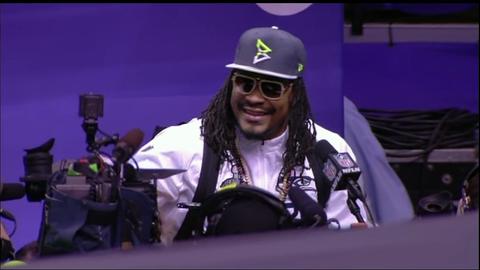
In the hype leading up to the Superbowl, the biggest story may be Marshawn Lynch's interactions with reporters. This style of interaction appears to be spreading to other sports stars as well and it makes me wonder about the role of sports journalists. In today's social media dominated society sports stars and fans have more direct access to each other than ever before and as with other sectors being revolutionized by technology the middle man is being cut out.
Sports writers used to be the conduit between athletes and fans, but today athletes and fans can connect through any number of avenues from Twitter, to Facebook, to Tumblr, to personal websites or even reddit. Athletes can use any combination of these social media outlets to craft their own narrative and relationship with fans rather than relying on sports writers to dictate their image. This changing relationship between athletes and sports writers appears to be similar to what is happening between researchers and science writers. A number of researcher friends have posted and commented on this recent poll complaining about the disconnect between beliefs/perceptions of the public and scientists. So what is causing this disconnect, does the responsibility of science understanding fall to the general public, the scientists communicating their findings, or science writers translating findings from scientists to the general public? As social media has opened up new avenues of communication for athletes, it also has for researchers. Grant organizations are recognizing the importance of putting in knowledge translation plans in place before projects start. However, without the public being interested in learning about science findings, whether the information comes from science writers or researchers, translating science may just be akin to throwing paper in the wind.
The poll I linked earlier also had a number of interesting questions about the role of science in society. More than half (57%) and a little under half, (43% and 40%) of scientists thought that major problems are that there is a lack of public interest in science, lack of media interest in science, and too few scientists communicating findings. While the public has a fairly positive view on the impact of science on society, there is a trend towards negative feelings with the public lessening in their perception of U.S. achievement in science, the contribution of science to society and the return on investment in science. So it seems that while science and researchers are attempting to reach out more than ever, the public may not want to hear it. Before science and researchers work on knowledge translation it seems that we need rehabilitate the image and trust in science and researchers.
A recent demonstration of the public's mistrust in research and higher education comes from Wisconsin where Governor Scott Walker has proposed a slashing of $300 million from the UW-system over the next 2 years in order to help balance the budge and offer the institutions more flexibility in their own governance and spending. After announcing the plan and receiving backlash he also suggested that professors teach more classes because they were not doing their jobs on the 2-2 schedule of teaching at large research institutions. This brought noted backlash from professors and others in higher-education who suggest that between research (the most highly valued asset at research institutions) teaching and service, professors spend over 50 hours a week working. However, others are unwilling to "break out the tiny violins" and see professors and researchers as underworked and overpaid. Interestingly, the article links a page that lists UW-system pay and if you look at the first page the top 3 paid employees are coaches and sports administrators while the rest of the page is almost entirely dominated by marketing, economics and law professors making a fraction of what they could make outside higher education (pay for these professors is 2-5 times higher than other disciplines because of the competition/availability of jobs from the private sector). So before we can work on knowledge translation, we need to work on the image of higher education and research so that the public can trust and be interested in research.
Edit: 1/30/2015 - I was looking more into the Wisconsin higher education budget issue and see that it parallels the battle with K-12 teachers in the state just 4 years ago with many of the same claims, that they are overpaid and underworked. It seems that much of the misunderstanding of teachers at K-12 that is magnified at higher education levels is that time spent in the classroom in front of students is the only time that should count as work.
Edit 2: 1/31/2015 - I found this article discussing the same issues and article that I mention here about the divide between the public and science/higher-ed. They offer one possible bridge with open forums for scientists and the public (in particular those who are most against various scientific findings - vaccines, GMOs, etc) to discuss issues.
Edit 3: 1/31/2015 - Great discussion on Science Friday about the Pew findings
Monday, January 19, 2015
BRAINFest! Report


On Saturday January 17th I helped with BRAINFest! which was held at the Ontario Science Center and organized by the Ontario Brain Institute. The Science Center is holding a few month long exhibition called BRAIN: The Inside Story which has exhibits and installations that help children and adults alike learn about the brain and how we think. Over the weekend of January 17th and 18th, the Science Center also held BRAINFest! In their exhibition hall (which interestingly I saw 2 couples looking at for their wedding reception while I was there) they hosted a number of groups from across Toronto and Ontario who were interested in the brain in some way. I went to BRAINFest! as a part of Let's Talk Science which is a nationwide organization that builds interest and engagement in science, engineering and mathematics. We had a few experiments, one on hand-eye coordination and a second on reaction time. We also build neurons and had a brain puzzle and quiz.


The Brain Exhibit itself was amazing! There were a number of artistic representations of neurons and parts of the brain as well as tons of information about the brain, cognition and rehabilitation. I took a few photographs here. The fest and exhibit reminded me of the Brain Fairs that we hosted at the University of Iowa except on steroids. One thing that I was very proud of with our Brain Fairs were that they were always offered in public spaces that were easily accessible, meaning that anyone could attend them. We were specifically hoping to target families who may not always have access to these types of educational experiences. A great offering at the Iowa Children's Museum was Family Free Night on the last Friday of every month. I was a part of two engagement projects on Family Free night (Brain Fair and Childhood Numeracy with the DeLTa center) and we saw well over 1000 people each time. So while the BRAINFest! was amazing, I had hoped to see more or steeper discounts on ticket prices in order to allow more people to enjoy such a fun and informative event.
Friday, January 16, 2015
BRAINFest!
I recently stumbled across a blog post about neuromyths and the responsibility that neuroscientists have to communicate neuroscience research to the public. This weekend I'll be doing my part by taking part in BRAINFest! at the Ontario Science Center in which the public will be able to interact with a number of displays, experiments and demonstrations and speak with researchers, clinicians and practitioners about the brain.

A list of activities include:
I'll be there with Let's Talk Science from the University of Toronto to engage school-aged kids on different neuroscience experiments. I'll write about my experience of the event afterwards.

A list of activities include:
- Cracked: New Light on Dementia(Sunday only)
See a research-based drama that challenges the way dementia is presented and discussed. - My Virtual Dream
Come watch this cutting edge production. Lucky volunteers will get to use their brain waves through wireless headsets to co-create a spectacular panorama of dynamic colours, sights and sounds. - Roboticize Me
Attend the world premiere of the CBC Doc Zone documentary film about robots. Evening event - Tickets required. - Hot Science
Listen to researchers and patient advocates talk about hot topics relating to brain research and brain health. - Brain Injury and Concussion
Parachute Canada presents brain injury related activities and simulations including Jello Brain to show brain fragility. - Addiction and Schizophrenia CAMH presents a schizophrenia virtual reality experience – special navigation and motivation through a virtual city.
- iPod Project Learn about the Alzheimer's Society Toronto's iPod project where they provide seniors with an iPod and a playlist of music to decrease stress levels and improve quality of life.
- Brain Disorder Augmented Reality Explore information about brain disorders in displays incorporating AR.
- Ontario Brain Institute Entrepreneur Demos Demos include: Avertus - EEG Headband; Sense Intelligent - Seeing Sound App; Sound Options - Tinnitus Device; POND - Anxiety Meter for Autism.
- Augmented Communication Devices Interact with Holland Bloorview's PRISM Lab Technologies using reliable body function to build communication mechanisms.
- Brain Research and Big Data Find out the latest from the Ontario Brain Institute's Brain-CODE Team - Big Data and Research panels as well as a pixel brain drawing activity.
I'll be there with Let's Talk Science from the University of Toronto to engage school-aged kids on different neuroscience experiments. I'll write about my experience of the event afterwards.
Tuesday, December 16, 2014
(Mis)communicating science
 |
| ISTOCKPHOTO/THINKSTOCK |
Within the last week the issue of science communication was raised in two different tweets:
The point when science becomes publicity from @mjsutterer
and
100 Most followed Psychologists on Twitter from @AkiNikolaidis
The first article discusses a recent retrospective study that might be best summed by Public Enemy:
with the authors concluding that over-exaggerations in news coverage of scientific articles is more likely to occur when the press release from the university includes exaggerations. Both the article and an accompanying editorial state the importance of the press release in communicating science to a broader audience. But this article comes at an interesting time where scientists have more avenues than ever to communicate directly with the public, including twitter, facebook, reddit, and personal blogs and scientists are even encouraging other scientists to get out and tweet (here and here).
This push of scientists to toward twitter made me really interested in the second article published by the British Psychological Society listing the 100 most followed psychologists and neuroscientists on twitter. I have previously posted about science and twitter and I wanted to conduct a similar study with these 100 psychology twitter accounts. Before starting, I thought the process would be easier than it ultimately ended being. First, finding an individual authors total citation count is almost impossible. I used the Scopus database and already know that I am likely underestimating and certainly missing citation counts (my own citation count on Scopus is underestimated by 33%). Other metrics are also very difficult to get ahold of when searching in 100 different places. So before presenting the data, I realize that much of it is somewhat off (Twitter counts are old, citation counts likely only from Elsevier based journals, and other information only from what I could easily find and discern from webpages).
Turning to the data, while many citation accounts are missing, there appears to be almost no relationship between academic impact and twitter followers. As I collected the data, I started to wonder, what does account for increases in twitter followers. I've started to think of a few other influences (I'm ignoring twit-iquet, as that has been discussed a number of times before, here and here for example) that may increase follower account. On the google doc I've linked, I'm hoping others can help fill in the blanks and perhaps explain how and why psychologists can best communicate with the public. I'll be tweeting a link to the google doc and the image below to the 100 accounts to see if I can fill in the information and see if anyone can propose other possible influences.

Subscribe to:
Posts (Atom)